
Popular Posts
-
So here I am at Day 23, barely skirting 10 000 words. I haven't had a chance to write in the last couple of days...work, day trips, work...
-
So here I am on Day One of NaNoWriMo and I'm writing a blog post. But guess what, bitches? This girl has reached her target word count f...
-
 Besides writing I try to spend a lot of my free time being artistically creative. One thing I enjoy doing is digital art, mainly photo-manip...
-
I can hear you now: "Ugh! No one should use outlines when writing a novel! You should write as the story happens!" Spoken like a t...
-
One night not too far ago, I was laying in a half awake half asleep state during the night. I came up with a neat idea: Digital Scavenger Hu...
-
I'd love to say that I haven't posted in this blog because I have been diligently working on my novel and keeping up with my daily w...
-
 It's been two whole months since finishing NaNoWriMo and I have spent that entire time struggling through a novel I've been writing ...
-
Hurrah! Hurray! It's Day 1 of NaNoWriMo! I was reading through blog posts of previous years I had attempted NaNoWriMo, and for the recor...
-
Forgive me fellow writers, for I have sinned. This is my first confession. While behind on my word count I went back and edited some of m...


1. Ignore the Editor
Always easier said than done. While I do allow myself to go through what I've written and fix a few things here and there, I do not allow myself to focus on grammatical issues or wording. Instead, I change certain plot issues in order to make the story flow and seem more cohesive. Nit-picking can wait until I go through the first draft.
2. Set a Goal
This tip I only began to adhere to recently. For the past couple of months I've been fretting over how much of the story I was actually writing and felt as if I had accomplished nothing by the end of the day. Starting this week I decided to allot myself a daily word goal of 350 from Monday to Friday (thanks to Chuck Wendig and his great blog for this advice). It may not seem like a lot, but it's really easy to do and I feel like I've accomplished something each day. Can't write on a Tuesday? No problem, just write 700 words on Wednesday. Wendig's reasoning behind this goal is that within a year of following that pace you can finish a novel. Since I started this regime at 50 000+ words, I know it won't take that long. I also know that I will write more on some days and also contribute to my word count on the weekends.
3. Just Write
Stuck in your plot? Not sure where to turn next? Just write! Whether you continue on at your stopping point or work on something that happens later on in the novel, keep writing. Eventually it will all come together and instead of wasting time banging your head against a wall you will be even closer to achieving your goal.


When most of us put together a puzzle, we don't simply start at the top and work along row by row. No, we usually establish the border, sort by similar colours, and put together what we have. Then, after we have pieced together chunks of the puzzle, we put it all together to complete the activity.
This is a splendid metaphor to describe how I write and I want to explain why this method is effective. While discussing writing techniques with someone I know, she scoffed at my idea of writing bits of the story here and there. She only writes from beginning to end. Which makes sense, since that is how the story is read. Personally, if I subjected myself to such a strict method of writing I'd get absolutely nothing done.
I find when I write things that happen later on in the story, it creates an opportunity to fill in those Point A to Point B gaps with information that will set up what is about to happen. If I know X, Y and Z are going to occur, I can provide information early on and alleviate those moments where I stare blankly at the screen going: "Uhhhhhhhhhhh......"
"But what if the story changes and those scenes are irrelevant?"
Oh well. Change it, get rid of it, move it around. It doesn't matter. It's my experience that it's best to just write something, anything, than to write nothing at all.
In other aspects of my life I tend to be an all or nothing person. Why bother putting all my clothes away in my bedroom if I'm not going to vacuum and change the bedding? Why clean the toilet if I don't have time to also scrub the sink and bathtub? I try not to be so rigid in my writing, taking delight in having written something instead of expecting to write everything.
However, this poses a problem when I am suddenly faced with the task of connecting my main storyline with something I have previously written. Sometimes this happens effortlessly, but most times I am stuck at a point where I know something I've written before has to happen. I'm just not sure how to get there.
So I present a post dedicated to bridging the gap between Point A and Point B, A being where I am in the narrative and B being where I need to go.
1. What needs to happen between the two plotlines?
The characters are trapped in limbo in one part of the story and they need to get to another part. Certain things must happen for B to occur. If I could just plunk the existing scene into the story, I wouldn't be writing this point. When we think about what needs to happen first, we don't necessarily have to focus on physical actions. Sometimes we need to consider how the characters' feeling must change in order for B to make sense.
For example, in my current effort, I am stuck in a sort of meh scene where not much is really happening. What I want to do is add in something I have already written because, well, it's time. I'm not going to sweat over what actions need to occur. Instead, I'm going to look at how the characters are feeling and interacting and think about how they will feel and interact in the new scene.
Try working backwards from Point B to Point A It's often easier to figure out how to finish the journey then to conceptualize how it started.
In order to do this, I grabbed my trusty notebook and jotted down what had just happened in the story. I then left a few lines blank and wrote what happens in the scene to be added. Now all I need to do is scribble in what has to occur in between. Have I done that yet? No. I decided to procrastinate instead and write this post.
2. Go big or go home?
Now we know that SOMETHING needs to happen between A and B, but how big should you go? That all depends on Point B. Is Point B dramatic or story changing? Is it highly climatic? If so, then the middle ground should be low key and work on building up the big scene. What if Point B is mundane and merely moves the story along? Depending on what point of the story you are at, you can go either way. Think about whether it's time for something exciting or if a slower pace is more appropriate.
3. How big does the bridge have to be?
So how much bridgework are we facing? Let's use a bridge as an example, since that seems appropriate.
You need to figure out what kind of distance you are covering. If the middle ground is a body of water, you need to figure how wide it is and what kind of bridge you need to build. If you're facing a small stream then obviously you don't need a big, fancy bridge. Something short and sweet and simple will do. However, if the body of water is massive then you need to build something bigger, higher and with more structural support.
4. Invest in a good computer.
This point may seem out of place in the scheme of things, but I think it's great advice for anyone trying to write a novel. Nothing kills a train of thought quicker than a system that freezes and lags. I swear to god if this thing lags up one more time while I'm trying to write this post, I will vomit shards of rage.

Side Note: Immediately after writing Point 4, Firefox lagged twice, crashed and then disappeared. Thank the Lord Baby Jesus that Blogger saves drafts.
If you don't know what the hell I'm talking about, see Part 1.
So far I've described the first two steps in utilizing the Snowflake Method. Now bear in mind that I am not following a specific guideline for doing this...I'm just sort of winging it. Just to reiterate, Step 1 involves throwing down a basic outline for your story. Step 2 addresses each scene with various questions about setting, feelings, characters, etc.
Step 3 is where I found the specifics of my story. I began with the simple scene descriptions of Step 1 and started adding scenes that occur in between. Let's look at my example from Part 1 (not my NaNoWriMo story) and add some scenes:
1. Man loses puppy.
- He calls his estranged brother for help, but his brother refuses, tells him to suck it up
2. He searches the neighbourhood.
- While talking to an elderly and lonely neighbour who lures him into the sitting room with tea, they talk for two hours
- After many hours of searching he sleeps on the porch with a bag of treats, periodically waking up to shake them
3. He posts fliers and ads.
- After a week of no responses from his ads and fliers, the man locks himself in the bathroom with his phone
etc. etc.
I'm not going to bother writing out an entire outline because that would be a waste of time on such a ridiculous premise. Although I challenge anyone to actually write this story.
Once you have determined the scenes that move the story forward, it's time to move on to what I like to call Step 4. In Step 4, you basically write out random scenes that come to mind that don't really fit in, or you expland (which is expanding and explaining) scenes from Step 3 that you feel need more information.
Easy-friggin-peasy, right? I'm sure there is potential for more steps in this process, but it's November 1st and my prep time is over. It's time to write that novel!
"Ugh! No one should use outlines when writing a novel! You should write as the story happens!"
Spoken like a true never-has-participated-in-NaNoWriMo-er.
I've committed myself to participating, and succeeding in, NaNoWriMo (National Novel Writing Month). For those of you not in the know, this is a worldwide events in which people challenge themselves to write a 50 000 word novel during the month of November.
Easy-peasy, I know.
After a couple of tried-and-failed attempts, I've decided to approach November as prepared as I can possibly be so when the 1st hits, all I have to worry about is writing. It's like sorting all the puzzle pieces by colour before attempting to put it together.
So I've been doing my research (and you know how I love getting technical). Writing an outline was certainly not my first step, but it's the one I would like to address now. And I discovered a nifty little strategy called "The Snowflake Method".
The premise is this: You start very basic and build onto the outline by adding more detail. Let me demonstrate:

And now I'll explain how I practically applied this to my NaNoWriMo project.
Step One
I started off with a basic outline. For example (and not from my project), you're telling a story about a man who loses his puppy and how he falls in love with the woman who finds it (again, not my project). First, you start with the basics.
1. Man loses puppy.
2. He searches the neighbourhood.
3. He posts fliers and ads.
4. His depression causes him to development a drinking habit.
5. While attempting suicide he receives a call from a woman claiming to have found his dog.
6. He unties the noose from his neck and meets her at a park.
7. Elated with joy, he discovers she does in fact have his dog.
8. Out of appreciate he takes her to dinner.
9. They fall in love.
Step Two
Question each scene.
1. Man loses puppy.
- How did the puppy get lost?
- How long did he have the puppy for?
- How does this make him feel?
2. He searches the neighbourhood.
- Does he walk or drive?
- Does he knock on doors?
- Does the search make him anxious?
3. He posts fliers and ads?
- Where does he post them?
- Does anyone help?
Etc...etc...
TO BE CONTINUED...


- Sight: she closes her eyes
- Smell: they are in an old orphanage; must; old-attic smell; his hair; the smell of his shirt
- Hearing: the setting is quiet; their breath; her heartbeat; the squeaking of the bed they are lying on
- Touch: his hand in her hair; her hand on his face; his shirt - the material
- Taste: this one is kind of obvious, since it involves the mouth; how he tastes
Now you need to think about the style of your story and the context of the kiss. Is this a moment of raunchy, passionate love? Or is it a sweet, tender moment? The words you use are important to describe the nature of the kiss. Physically descriptive words are better suited to something more gritty whereas vague wording is probably more appropriate to something more emotional. Par exemple:
- The statement: "He kissed her."
- Raunchicized: "He pushed his tongue into her mouth, forcing her lips apart. He explored every crevice and pushed himself onto every taste bud."
- Tenderized: "She couldn't help but part her lips as he gently pressed against her. The presence of his tongue was soft, comforting yet exhilarating."
The problem with describing kissing or ****ing or anything else like that is that there is little in this world more boring than reading descriptions of what meaty parts rubbed up against what other meaty parts.Some may think me ridiculous for delving so deep into the mechanics of writing a kiss scene. Others may have been expecting more details on exactly what words to use when describing a kiss. People create in different ways. While some believe all an author needs is an idea, a pen and a piece of paper, I'm afraid I cannot conform to that standard. I have the idea, the pen, and the paper but I often require more tools in order to translate what goes on in my head of crazy into words. I hope this article helps in providing tools for writing a kiss, but is it up to you to find the words.
The other option is to describe it in absolutely metaphorical terms. This can be easier or harder depending on the point of view of the novel. Compare:
"his lips sent cascades of little shivers as they delicately flitted over hers." (Yawn, but standard fare for romance novels and soft-core erotic fiction.)
"They kissed, and a flurry of chocolate butterflies settled in her soul, made love, had babies, and flew on." (interesting, whimsical, much more colorful, and leaves the reader in the best place to decide what that really means.)
cloister
How Do I Describe Kissing?


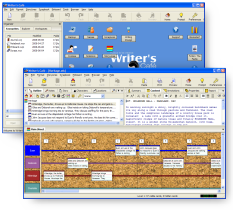
I downloaded a program called Writer's Cafe 2.33 (link|review) designed by novelist Harriet Smart. It's a helpful program that offers various tools to help author's during the writing process. Every time the program is opened it displays a screen that offers various tips and pieces of advice. I thought I would share some of those with you:
How to have fun
Here's the thing - you are not doing your taxes. You are not cleaning out the sewers. You are doing something much more glorious when you write. If you are fully using your imagination you should be having fun.
Enjoy your own imagination. Be like a child and play. Indulge yourself. This is one of the few places in life where you can be as wild and fanciful as you like. If you want to have a ballroom scene with a champagne fountain and dozens of liveried footmen, you can. It's your party. There are no budget guidelines. Bring on that superb band!
This is not to say that writing or storytelling is silly escapism. You will not be guilty of that, though other people might think so.
I used to be accused of daydreaming when I was a teenager. I resented the charge. How was it daydreaming when I was imagining myself as a young officer in the First World War, stuck in a trench, facing certain death? Daydreaming was silly wishing for material things but I was facing serious things in my imaginative world and dealing with important questions.
However there was enormous pleasure in this sort of escape. Using that imaginative muscle gives a buzz like no other. Ostensibly I was a powerless fifteen-year-old, but inside I was a super-being, with a world of narrative at my command. It sustained me like nothing else. It was fabulous to be able to climb into my trench and be a hero after a miserable day at school. I could step into that place and live something bigger, better, and more meaningful.
When we make up stories we are using them to deal with the pain of reality. We find that serious things can be dealt with when dressed in the bright clothes of stories. Shakespeare understood this and this is why we go back to his plays time and time again and see truths in them. Good stories celebrate life and deal with it at the same time. This is why we are all so hungry for them. We need them.
So you are allowed the self-indulgence of creating them in the first place. You do not need to justify your pleasure in the process. You can just enjoy yourself. Taking pleasure in it will make you more relaxed and if you are relaxed you are more likely to write well, by which I mean you will write authentically and with insight.
If you keep saying to yourself "Oh no, I can't say that, that's much too vulgar or not right for this sort of thing," you will run out of words. You will freeze with the pen in your hand.
Take pleasure in the act of doing it now, without worrying about the results. I just watched my ten-year-old daughter decorating a cover for a school project. She was happily absorbed writing her name and the title in fancy letters, in different colours and then drawing a row of flowers with striking swirly centres. She was not concerned with correct layout or what her teacher would think. She was doing it, in that moment, because it pleased her. The result was not as important as enjoying the process.
Children do stuff just because it's fun. We should do that with our writing. Do it not for results but for the sheer love of the process.
Have fun!
Technology, that's who.
So here is a list and review of some software I tried.
1. Storybook
Storybook is an open source program designed for Windows.It helps to structure and organize plot by providing an overview of multiple plot-lines.
Don't bother downloading! As I was writing this post and attempting to install the program, it decided to go ahead and download a toolbar I specifically declined to have installed. This resulted in me having to restart my computer which took up 10 precious minutes of procrastination time. Not cool.
2. Writer's Cafe 2.33
Writer's Cafe, a free download available for Windows and Mac, is a self-proclaimed "playground for the imagination". Its main feature is StoryLines, which helps to structure your story.
From the website (because I'm too lazy to paraphrase): "Designed by published novelist Harriet Smart, Writer's Café also includes a notebook, journal, research organiser, pinboard, inspirational quotations, daily writing tips, writing exercises, name generation, and a 60-page e-book, Fiction: The Facts, distilling 20 years of writing experience."
Okay, so it seems to have everything a author needs, with the exception of a direct link to FailBlog. I do like the fact though that it's called a "Cafe" since I often wish to sit in a artsy location and write my book. Those you can't do find a way to on the internet.
I'm not going to go into great detail about all the features this program has to offer but I wanted to check out StoryLines. As a non-linear writer (someone who cannot write a story from beginning to finish), I tend to write different chunks of a story and then lose track of what the hell I've written or I am unable to string the portions together. The interface is very pretty but there is no clear indication as to what one does once they begin StoryLines.So as any cornered animal would do, I click on "New" and start a new project.
Success!
From here I can add "cards" to identify different scenes in my story and from there I can rearrange them to suit my plot needs.
Overall, I think this program is highly useful in organizing a story. Give it a try! The only downfall is that an unregistered copy has limited features.
I just had a thought. Well, I have many of them but I thought I would post this one. I was thinking about composition and the technicality of writing. Authors are like pianists: Some play by ear and some must learn each note and finger position. Authors either write naturally or must learn about language and writing in order to write.
Despite what kind of author you are I think it's important to learn about writing. Sometimes we get so wrapped up in how the story is playing out in our heads that we forget how to communicate it clearly into written word. Taking the time to educate ourselves about the styles of writing may make the difference between a well written story and a heaping pile of garbage.
A few minutes ago I dusted off my copy of Strunk and White's Elements of Style. I was required to purchase this book during my first year of university and like any typical student I barely touched it.
Today's post is brought to you by....
Commas!
Commas, commas, everywhere! These pesky grammatical creatures are easily overused and underused.
When using commas in a series of 3 or more words, use one after each term. For example: She preferred the yellow, orange, and red dress. Note the comma after orange yet none appears after red.
Commas are a great replacement for parenthetic expressions. This means that commas can be used to insert a separate yet related thought into a phrase. My brother, the paramedic, is getting married next week. A good rule if thumb is to imagine the sentence without the part between commas and determine if it still makes sense.
"noirness, this is all well and good, but when do I use a comma when it comes to conjunctions and introducing an independent clause?" Whew, I thought you'd never ask. When using conjunctions to connect dependent clauses with independent ones, place a comma before the conjunction. He noted the front door was open, but no one was home. She wished she was somewhere else, or dead. Slippy did not wish to leave the ocean, for fish cannot breath above the surface.
Use commas instead of periods. Sometimes two sentences can be combined into one fluid thought simply by using a comma. He was a wild one. He lived on the edge. VS He was a wild one, living on the edge.
And that's my crash course on commas. Here's your challenge - read through the post and see if you can find where I've misused or missed a comma. I've snuck some in there to test your astuteness.
Everyone's right!
And if someone is reading this, then you do not exist.
So I've taken up writing again...because it's more stimulating than knitting and more productive than doing nothing. Plus, I figure in order for me to live in financial comfort benefiting from something I enjoy doing, I better get something published.
Having reached a point where further creation of my story requires actual thought, I decided to explore the finer art of writing and began my education with the structure of plot. (After spending hours learning all I can about the Resident Evil video games on Wikipedia...ah, Wikipedia. You be a blessing and a curse.)
Sure, we all learned this crap during our days of public schooling, but never has it become relevant than when I am actually trying to develop a plot. Plot structure is my fractions, the useless information I tell myself, "I will never need this in the real world."
Hello, Real World, I am having problems developing my plot.
Without further ado, here is what I have learned about plot and plot development (in simplistic, easy to not overthink terms):
 1. Exposition (background information)
So a story has to begin somewhere, and that somewhere is with the characters and the conflict. As a writer you must create an emotional involvement between the reader and characters...because if they don't give a shit about the person then they won't care what sort of issues they have to deal with. And you have to outline the issue, because a character wandering through life all la-dee-da is boring. Conversation, narration or character musings are great ways to introduce this information. Just don't lay it all out at once...iNfOrMaTiOn OvErLoAd!!! Spread it out over two or three chapters, giving the reader a reason to continue.
2. Rising Action (introduction of main conflict)
So now that we know who we are dealing with and what the issue is, we need to flush out the actual conflict the character(s) will face. This is the main problem that will be eventually dealt with through character action. The rising action should involve crisis, tension, excitement and complication. This is also where the characters will become aware of this problem and take steps to battle it.
3. Climax (high point)
This is the moment we've all been waiting for. The is the main event, the big tamale, the darkest moment, the hardest challenge...Our hero could fail. There is always a possibility of impossibility as our character faces his crisis head on. The climax is the physical or emotion turning point of the entire story...how will the problem change our hero?
4. Falling Action (winding down)
Here we can exhale that long held breath as we clenched our fists in anticipation of the climax's outcome. What is the result of the actons or decisions made or taken during the climax?
5. Resolution (the end)
All good things come to an end, and thusly this is where the story concludes. Tie up your loose ends. Wrap it all up with a shiney bow (or a grisly one). Don't leave the reader hanging...unless a sequel is in the cards.
Okay, so knowing what a plot involves is great, but how can we apply this knowledge to our writing? Simple, we outline.
AAAAAAHHHHH! Outlines!!!!
I'm not talking the high school point-form outline of our torrid educational past. I'm talking about talking to ourselves, making notes, planning. The only person the outline needs to make any sense to is the writer. Here are some ideas I've gathered on how to outline your story:
1. Story Wheel
Yay! Wheels are fun! Draw up a wheel, split it into 6 sections (characters, theme, action, motive, conflict and resolution) and write in each space what you know so far. You can also make wheels for each characters. This is will give you a layout of what your story involves.
2. File Cards
My method of choice. Use filing cards to write down individual scenes, character information and other plot components. This way you can rearrange the cards and organize a timeline as well as incorporate useful information such as character background.
3. Storyboards
I always think of DVD special features when I think of storyboards. You don't have to be a Pixar animator to create a useful storyboard. Use stickfigures, shapes, whatever. Just draw and label major scene in frames in the order they occur. This is a great visual tool for understanding where your plot is headed.
And that's all I got. RESOLUTION!!!
Probably.
This conundrum led me to do some research on the proper use of flashbacks. From what I've discovered (and I'll post links to my findings below), flashbacks should only be used sparingly...which is no help to my cause. See, I'm not back tracking on a character's personal experience but rather certain events leading to the main plot. Another thing I learned is that the flashbacks should definitely be punchy and exciting or their presence may insight a yawn-fest. Most helpful, though, was the idea of using flashbacks when the main plot gets a bit laggy.
Other than that, my wasted time researching did not solve my quandry.
- http://storysensei.blogspot.com/2007/07/some-tips-for-using-flashbacks.html
- http://www.plotcafe.com/writing-techniques-using-flashbacks-to-enhance-your-fiction-stories/
- http://www.scribblepad.co.uk/writing-flashbacks.html
- http://www.coloradospringsfictionwritersgroup.org/archive/2002-04_article-the_art_of_flashback.pdf